Parkinson's and Sleep Apnea Fuel Each Other
Parkinson's disease and obstructive sleep apnea are locked in a devastating feedback loop, where each condition exacerbates the other through shared molecular pathways, creating a complex clinical challenge that current, siloed treatments fail to address.
The information in this article is for educational purposes only and is not intended as medical advice. Always consult a qualified healthcare professional for medical questions.
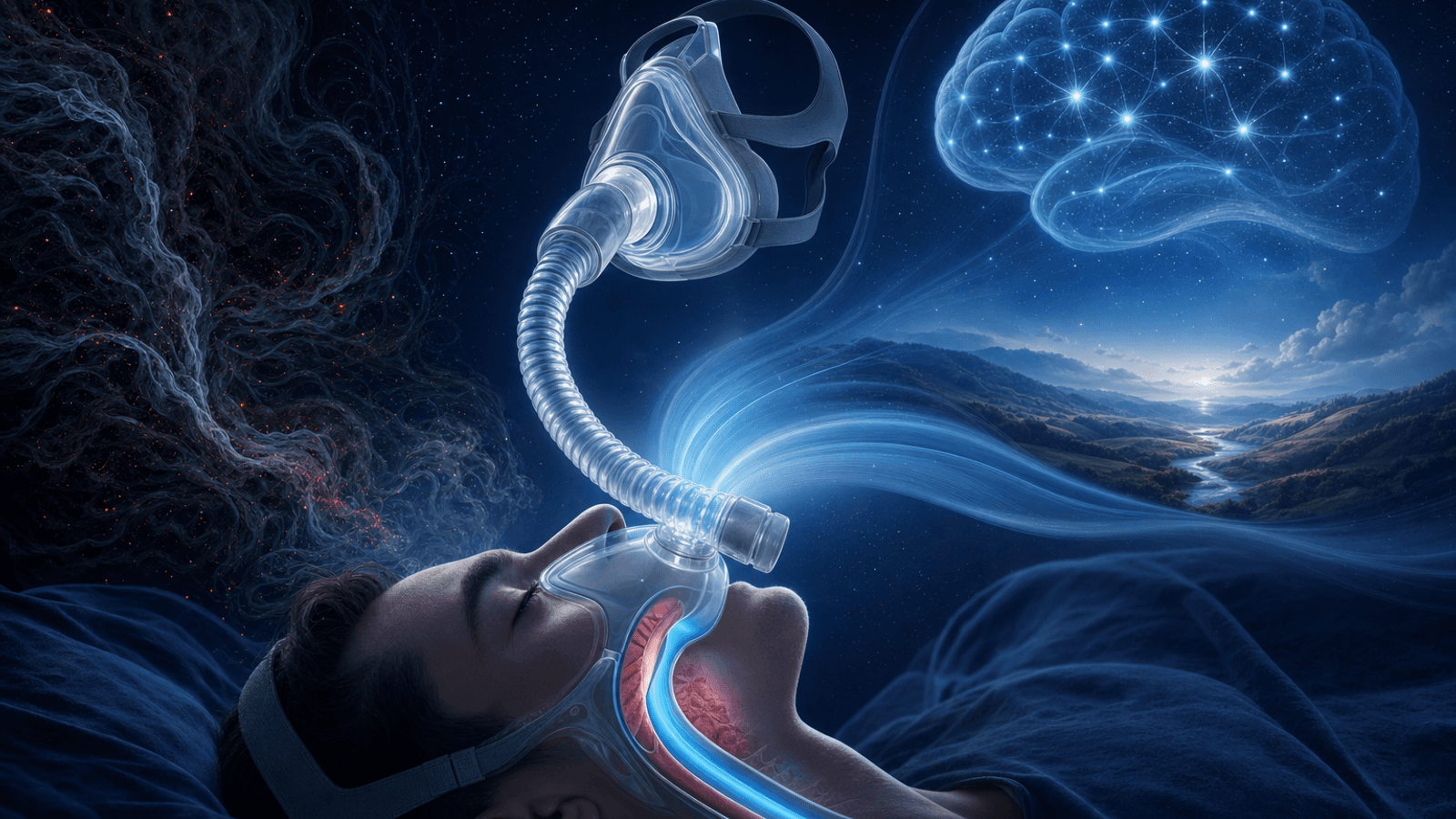
Summary
This article uncovers a destructive feedback loop between Parkinson’s disease (PD) and obstructive sleep apnea (OSA), where each condition worsens the other. Readers will learn how this “civil war” in the brain unfolds: - OSA accelerates PD: Oxygen deprivation from apnea causes oxidative stress, while sleep fragmentation prevents the brain from clearing toxic proteins linked to Parkinson's. - PD contributes to OSA: Muscle rigidity and neurodegeneration from Parkinson's weaken the airway, making it prone to collapse during sleep. Crucially, a large-scale study found that treating OSA with CPAP therapy significantly reduces the risk of developing Parkinson's, transforming sleep treatment into a key strategy for brain protection.
Imagine a patient with Parkinson's disease whose daytime motor symptoms are managed with medication, yet whose nights are restless and unrefreshing. Parkinson's is a chronic, progressive neurodegenerative disorder characterized by both motor and non-motor symptoms, and sleep disturbances are among the most common of those non-motor features. Increasingly, researchers are recognizing that one such disturbance—obstructive sleep apnea (OSA)—is highly prevalent in Parkinson's patients, with estimates ranging from roughly 20% to 70%, compared with 2% to 14% in the general population. Studies suggest this overlap is more than coincidence: OSA appears to be a clinically relevant, and potentially treatable, companion to Parkinson's disease.
Researchers are uncovering a destructive alliance, a feedback loop where each disease makes the other worse. Even levodopa, the cornerstone Parkinson's drug that calms tremors by day, may worsen obstructive sleep apnea at night by impairing pharyngeal muscle tone. This therapeutic paradox has peeled back the curtain on a complex civil war waged within the body, revealing that the fight for the brain’s future may be won or lost in the darkness of the bedroom.
A Two-Front War
Obstructive sleep apnea, a disorder where the throat passage becomes to narrow, and the muscles that should hold it open fail to do so during sleep, is shockingly common in people with Parkinson’s. While it affects between 2% and 14% of the general population, studies show its prevalence skyrockets to between 20% and 70% among those with the neurodegenerative disease. Scientists now understand this overlap is no coincidence but rather a “vicious cycle,” a two-front war where each condition actively fuels the other.
Consider first the assault from sleep apnea itself. Each time a person with OSA stops breathing, blood oxygen levels can fall, and rise again as breathing resumes. Researchers refer to this cycle as intermittent hypoxemia, and reviews of the OSA–Parkinson's link propose that it generates oxidative stress in the brain. That matters because Parkinson's disease is defined by the loss of dopamine-producing neurons in the substantia nigra. According to one review, oxidative stress from intermittent hypoxemia is among the mechanisms thought to damage dopaminergic neurons, and PD patients with OSA tend to show worse motor and non-motor symptoms than those without it.
Another mechanism proposed in reviews of OSA and Parkinson's is sleep fragmentation. Reviews suggest that fragmented sleep may interfere with the brain's glymphatic system, which has been implicated in clearing metabolic waste during sleep. According to these reviews, impaired glymphatic clearance could, in turn, allow proteins like α-synuclein to accumulate and aggregate more readily. In this proposed model, the brain's waste disposal system is compromised, offering one hypothesized pathway by which OSA might contribute to neurodegeneration in Parkinson's disease.
But the attack appears to be bidirectional. Researchers propose that Parkinson's disease may help create the very conditions that allow sleep apnea to thrive. The disease is characterized by muscle rigidity, and this doesn't appear to spare the muscles of the upper airway. As these tissues become stiffer and less responsive, they may be more prone to collapse during sleep. Furthermore, Parkinson's neurodegeneration extends deep into the brainstem, an area that manages the body's autonomic functions, including the rhythmic command to breathe. As α-synuclein accumulates in these respiratory centers and dopaminergic and cholinergic signaling falters, autonomic control of breathing can be disrupted, which researchers believe may contribute to worsening sleep apnea. The result, scientists hypothesize, is something like a feedback loop: Parkinson's may weaken respiratory control and airway tone, while the intermittent hypoxia and sleep fragmentation of apnea are thought to disrupt the brain's glymphatic clearance — a combination that some studies suggest could accelerate the underlying neurodegeneration.
The Molecular Fingerprint

To investigate this potentially devastating synergy, scientists have searched for direct evidence linking the oxygen starvation of apnea to the cellular damage of Parkinson's. One promising clue lies in the cell's powerhouses: the mitochondria. When a neuron is repeatedly deprived of oxygen, its mitochondria must scramble to adapt. Researchers have proposed that this frantic metabolic adjustment leaves behind a distinct biochemical impairment. This hypoxia-driven damage called “mitochondrial protein acetylation,” is a unique metabolic fingerprint. In essence, the stress of oxygen deprivation causes small chemical tags, called acetyl groups, to be attached to mitochondrial proteins. This isn’t a harmless alteration. These tags change the proteins’ function, impairing the mitochondria’s ability to produce energy efficiently and manage cellular stress. For a dopamine neuron already struggling to survive the onslaught of Parkinson’s, this mitochondrial dysfunction can be particularly detrimental. This molecular fingerprint provides a concrete, physical link between the macro-level event of a blocked airway and the microscopic tragedy of a dying neuron.
A Unified Strategy
The discovery of this feedback loop demands a radical rethinking of how Parkinson’s disease is managed. For too long, the two conditions have been treated in isolation. A neurologist manages the Parkinson’s, while a sleep specialist, if consulted at all, handles the apnea. This siloed approach is failing patients, especially since the symptoms—fatigue, cognitive fog, and daytime sleepiness—overlap so significantly that diagnosis can be challenging.
A groundbreaking study of over 11 million U.S. veterans has provided the most compelling case yet for an integrated strategy. The two-decade analysis revealed that veterans with obstructive sleep apnea had a risk of later being diagnosed with Parkinson’s disease that was nearly twice as high as those without the sleep disorder. The finding held firm even after adjusting for other risk factors, establishing OSA as a powerful, independent threat to the brain.
But the study’s most electrifying discovery was one of hope. The risk was modifiable. Veterans who consistently used a continuous positive airway pressure (CPAP) machine to treat their apnea saw their risk of developing Parkinson’s fall by approximately 30%. This protective effect emerged as early as two years after starting treatment, suggesting a critical window for intervention.
This transforms sleep apnea from a mere comorbidity into one of the few known, treatable risk factors for the world’s fastest-growing neurological disorder. It suggests that simple, non-invasive therapies could potentially alter the trajectory of a devastating disease. The implications are profound. The urgent need for better screening and management of OSA in people with Parkinson’s—and even in the general middle-aged population—is no longer just about improving sleep quality. It’s about proactive brain defense. By treating the battle that rages in the airway each night, we may give the brain a fighting chance in its war against neurodegeneration.
____
Updated August 1st 2026 to reflect minor changes suggested by our medical supervisor
Also in Parkinson's Disease

Bas Bloem: The Era of Personalized Parkinson's Has Begun
For one of the world’s leading Parkinson’s researchers, Bas Bloem, the future of the field begins with a radical shift in perspective: Parkinson’s is not one disease, but millions.

Claire Henchcliffe: Rebuilding the Parkinson’s Brain
Parkinson’s treatment has so far largely meant replacing lost dopamine. Neurologist Claire Henchcliffe is helping test a far more ambitious idea: rebuilding damaged brain circuits themselves.

Editor’s Note: Why We’re Building The Initiative
How we accidentally became the founders of a Magazine.