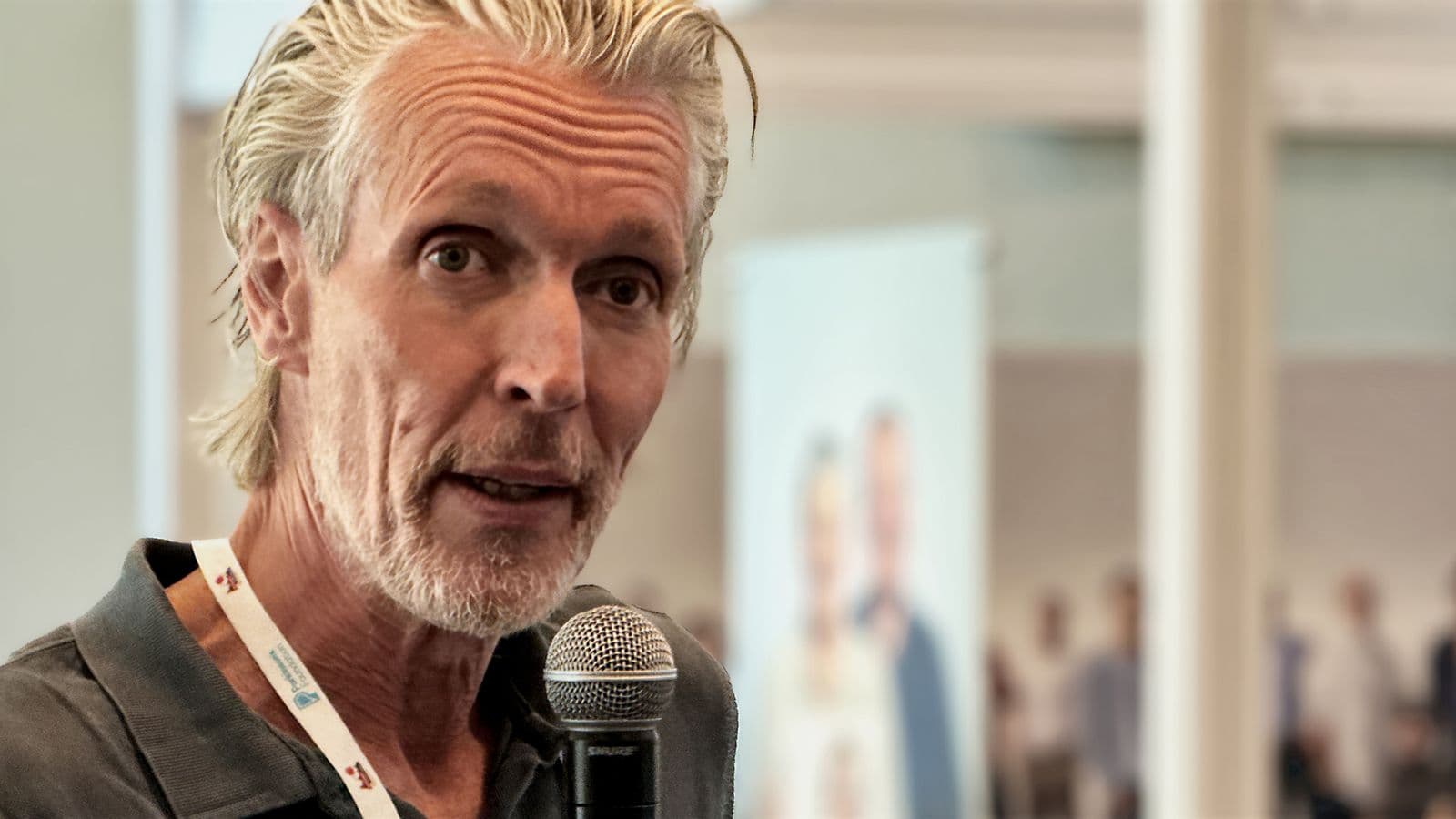
Charalampos Tzoulis: Fighting for a Breakthrough in Parkinson’s Disease
Charalampos Tzoulis may very well be one of the hardest-working scientists in the field of Parkinson's research. His single goal: Achieving the first real breakthrough.
The information in this article is for educational purposes only and is not intended as medical advice. Always consult a qualified healthcare professional for medical questions.
The room is quiet. Not the casual, chatty kind of silence that often fills a conference hall before a lecture begins. It is a different kind of silence. The Norwegian Parkinson’s Association has invited people living with a serious diagnosis, and in the room hang the questions everyone has come to find answers to:
Is something new coming soon? A breakthrough, a treatment that can actually slow the disease? What will life be like from here on?
For the people here, time is of the essence. How quickly will the body fail? How long can one walk without assistance? How long can one write, button a shirt, hold a child or grandchild in one’s lap?
“Today isn’t about the big breakthrough. It’s about achieving a first breakthrough. We haven’t had that yet.”
On stage stands Professor Charalampos Tzoulis, one of the leading voices in Parkinson’s disease research internationally. His work has earned multiple prizes and distinctions, and he is leading several of the most innovative initiatives in the search for new treatments for Parkinson’s disease.
In Norway, Tzoulis has built a research environment that is not only among the strongest in the Nordic region, but also among the most prominent in the world. The Neuro-SysMed Center for Clinical Treatment Research in Neurological Diseases and K.G. Jebsen Center for Parkinson’s disease, both led by Tzoulis, have become a hub for international research on disease mechanisms biomarkers and innovative clinical trials.
For many in the audience, Tzoulis is more than a researcher. He is a source of hope. At the same time, Tzoulis is a man who speaks with a blend of precision and unflinching pragmatism. No headline-grabbing promises. No quick wins. Quite the opposite.
“We still haven’t had a single therapeutic breakthrough other than symptom management. Despite decades of research we still lack a disease-modifying treatment for Parkinson’s disease – meaning a treatment that can delay or stop the rate of neurodegeneration and disease progression. That tells us something important: we are still missing part of the picture. We need to think differently, challenge our assumptions, and learn from the many disappointments the field has already faced.”
For Tzoulis, there is also a personal story in the background. Growing up in Greece, his family lived with a serious illness: his father suffered from progressive supranuclear palsy (PSP), a severe form of parkinsonism. He is careful not to reduce his career choice to that experience alone. Instead, he describes it as something that remained in the background over the years, quietly shaping his view of disease and, perhaps, the path he eventually chose.
More than 70 setbacks
Later, Tzoulis sits down in a small meeting room behind the stage in the conference hall. He explains in more detail how, globally, over 70 different treatments for Parkinson’s have been tested, without any proving capable of slowing disease’s progression.
“When you’ve tried 70 times and still failed to achieve a therapeutic breakthrough, that is a clear sign that something needs to be done differently.”
Tzoulis says this without bitterness. Almost clinically. Like a researcher who has watched an entire field of study run up against the same wall for decades.
There are treatments that to some extent improve symptoms; mostly levodopa. Technology that can buy time, like Deep brain stimulation. But there is still no approved therapy that can stop, or even substantially delay, the underlying neurodegenerative process. Is the premise wrong? Is the problem deeper than the lack of a single effective drug? Could part of the difficulty lie in the way the disease itself has been understood?
This is one important part of Tzoulis’s work. Alongside efforts to develop and evaluate new treatments, his research also asks a broader question: what if Parkinson’s is not truly one disease?
“It’s a syndrome. It’s a constellation of clinical disorders,” says Tzoulis.
For decades, Parkinson’s has largely been approached as a single clinical diagnosis, defined by symptoms such as tremor, rigidity, and slowness of movement. But according to Tzoulis, this common clinical picture may mask different underlying biological mechanisms.
“We have no biomarker today that allows us to simply take a snapshot and say that someone has Parkinson’s. Diagnosis remains based on a combination of clinical signs and symptoms.”
In other words, two patients who appear to have the same diagnosis may in fact be affected by quite different disease processes at the cellular level. That may also help explain why the field has so often struggled to translate promising ideas into therapeutic breakthroughs.
One in four
His colleagues describe him as extremely hardworking, with a restless energy in his approach to work. A determination not to let the field stand still. In recent years, one important line of Tzoulis’ research has focused on what may represent a mitochondrial subtype of Parkinson’s disease.
Mitochondria are the cell’s powerhouses, responsible for producing the biological energy the body needs to function. In a substantial subgroup of all individuals with Parkinson’s disease (approximately 20-25%), Tzoulis’ team have observed signs of marked and nearly brain-wide dysfunction in the mitochondria’s energy generation machinery, specifically the respiratory complex I.
“It appears that about one-fifth to one-quarter of people with Parkinson’s disease have such widespread mitochondrial dysfunction in their brain,” says Tzoulis.
“Mitochondria are like nuclear power plants. When they fail, you lose essential energy production, but you also get harmful byproducts that can cause extensive biological damage – so called free radicals.”
This is where the story begins to move beyond an individual research finding and toward a broader shift in how Parkinson’s disease may be understood. If a substantial proportion of patients have a definable biological subtype, that could pave the way for patient stratification and, ultimately, more tailored therapies.
But before that can happen, researchers must first be able to identify those patients using clinically applicable tests. Brain tissue is not something one can sample in routine practice, so the task is to develop accessible biomarkers that can detect the mitochondrial subtype in living patients. Developing such tools is now an important focus of Tzoulis’ research group.
Tzoulis is cautious. This is a difficult undertaking - still, the direction is taking shape: biomarkers, patient stratification, and targeted clinical trials. This is where the conversation starts to resemble treatment and research in oncology.
– With cancer, you can often take an image and see the tumor. With Parkinson’s, we don’t have that kind of direct target.
Why don’t you use biomarkers?
Tzoulis answers without reservation.
– We don’t have them. We don’t have good markers for diagnosis, stratification, or for following disease progression.
A system in transition
Tzoulis points out that the challenge lies not only in the disease itself, but also in the way clinical research is organized. To address this, he and his collaborators are developing two trial platforms: SLEIPNIR and HYDRA. Together, they represent a new approach to clinical testing, one in which several candidate treatments can be evaluated within a common framework, often with shared infrastructure and, where appropriate, a common control group. The aim is not only to move faster, but also to reduce the risk of costly late-stage failures.
Currently, a conventional late phase (Phase 2b/3) clinical trial in Parkinson’s disease can take five to eight years, require several hundred participants, and cost very large sums, with no guarantee of success. The problem is not only that breakthroughs remain elusive, but that each unsuccessful attempt consumes so much time and effort.
SLEIPNIR was designed to answer a more fundamental question earlier in development: does a candidate drug actually reach the brain and engage the biological process it is intended to affect? Treatments that fail at that stage can be filtered out before moving forward. The most promising candidates can then be taken into HYDRA, a larger and more adaptive trial structure designed to test several therapies more efficiently.
Taken together, the two platforms are intended to create a more rational pipeline for therapeutic development, one in which selection, speed, and scalability are built into the design. The goal is not simply to find a single successful treatment, but to improve the odds that genuinely effective therapies can emerge.
Hope without overpromising
For Tzoulis, however, treatment is only part of the picture. Another important frontier is prevention. What if neurodegenerative disease could be identified earlier, or even interrupted before the clinical phase is fully established?
This is one of the ambitions behind two newly awarded research centers that will work closely together: the Mohn Research Center for Neuroprotection and ICoN: Innovation Center for Neuroresilience. Both are built around a long-term shift in focus, from treating established neurodegenerative disease toward earlier detection, biological understanding, and prevention.
Treating symptoms is a major and necessary step forward, but stopping the disease before it even starts is the ultimate goal.
Back in the large conference hall, the mood remains subdued. The patients have not been presented with any breakthrough. No miracle cure.
Then comes the question many in the audience are really waiting for:
What is the most realistic timeframe for a breakthrough?
Tzoulis pauses to think before answering. Then comes the optimism. Cautious. Measured. Credible.
“Once the first brick falls from the wall, I believe the rest of the wall will come down quickly,” says Tzoulis.
“I believe that for someone diagnosed today, a breakthrough will occur within that person’s lifetime. I envision a treatment that could significantly slow the disease. And hopefully, in the near future, we will move even further upstream - towards early detection and true prevention.”
It’s not a promise. But it’s not just hope either. It’s perhaps the most realistic optimism a field with 70 negative studies can offer.
“We’re not going to give up.”
Also in Profiles
Roger Barker: Beyond the “Breakthrough”
“I don’t think we need a cure,” neuroscientist Roger Barker said. “If you can slow it down by 50 percent and pick people up early on, you’ve probably done it.”
Jimmy Choi at WPC2026: Why Exercise Has Become the Field’s Most Urgent Medicine
Despite decades of research and billions invested, scientists still cannot stop Parkinson’s disease. For now, says endurance athlete and Parkinson’s advocate Jimmy Choi, the most effective intervention available may be something far less futuristic than many has hoped for: Exercise.

Anders M. Leines: After the Image Changed
For more than a decade, Anders M. Leines has documented Parkinson’s from the inside. First, he wanted to change how the disease was seen. Ten years later, he returned to the same people, and found a darker story about time and identity.